Level 1What is 3D printing?
Printer · A clean, flat & level surfaceYour next step
What is 3D printing useful for?
Explain what 3D printing changes, and identify a sensible reason to use another process.
Begin with the job, not the machine
Start with what the part must do. Identify its user, purpose, environment and acceptance criteria before choosing a manufacturing method. A visual model, a fit prototype and a working component need different evidence. State the problem first; decide whether printing is a suitable way to solve it.
A digital shape becomes a physical object
3D printing builds a physical object from a digital design, usually layer by layer. It is also called additive manufacturing. Some processes deposit material through a nozzle; others harden resin, fuse powder or join sheets. The result can be a plastic part, a metal component or even a concrete wall element.
Same outside. Different paths inside.
Cutaway of the completed stage
WallsInfillTop layers
Front walls and part of the roof are cut away to reveal the interior. Paths are enlarged for clarity.
Layer 14: nozzle paths from above
Layer paths complete
Changing infill leaves the outer dimensions unchanged. More material is not a universal strength guarantee: walls, layer direction, material and the actual load also matter. About walls and infill
Walls & infill. Perimeters stack into the outer walls. Spaced internal paths form the infill; successive layers change direction in this example. Change the spacing to see how the same outside shape can contain different amounts of material.
Compare adding, removing and forming
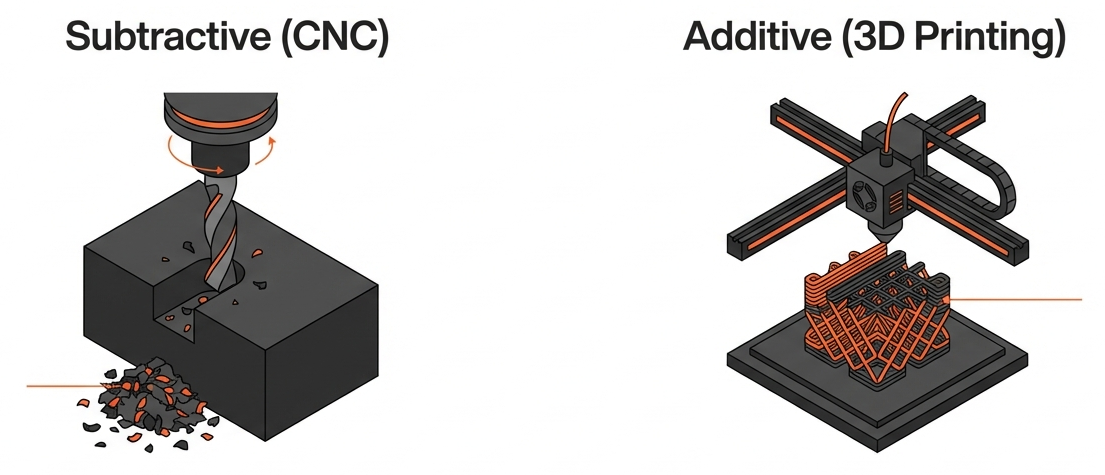
Compare printing with other ways to make the part. Machining removes material; moulding shapes material in a tool; sheet processes cut or form stock. Buying an existing item may be quicker. Compare quantity, geometry, tolerances, finish, lead time and total cost before choosing.
| Route | A useful reason to consider it | Question to ask |
|---|---|---|
| 3D printing | A custom shape or a design still changing | Can the process meet the required function and finish? |
| Machining or sheet fabrication | Stock material, a simple profile or a demanding interface | Can the features be reached and made economically? |
| Moulding | A stable design intended for repeated production | Does the expected quantity justify the tooling? |
| Buy an existing part | A suitable, documented component is available | Does it meet the actual requirements without redesign? |
These are starting questions, not fixed cost or quantity thresholds. A supplier may combine processes.
Separate a model, a prototype and a working part
A display model communicates; a prototype answers a question; a working part performs a task. Define which result you need. A prototype that proves fit may establish nothing about strength or durability. Judge each part against its stated purpose, rather than assuming a successful print validates every use.
Understand the attraction and the limits
Printing offers design flexibility, not unlimited capability. Complex or customised shapes can be practical without dedicated mould tooling. Build size, material behaviour, support access, finish and production time still impose limits. Include preparation, failed trials, support waste and finishing when comparing cost and environmental impact.
Practise deciding whether to investigate
Choose printing when its advantages match the job. A changing custom shape may suit printing; identical flat labels may be cheaper to buy or cut. Compare the finished result and required quantity. This level develops technology awareness; operating a printer requires the practical preparation covered in Level 2.
A reading marker for you. Passing the checks below unlocks the next lessons.